
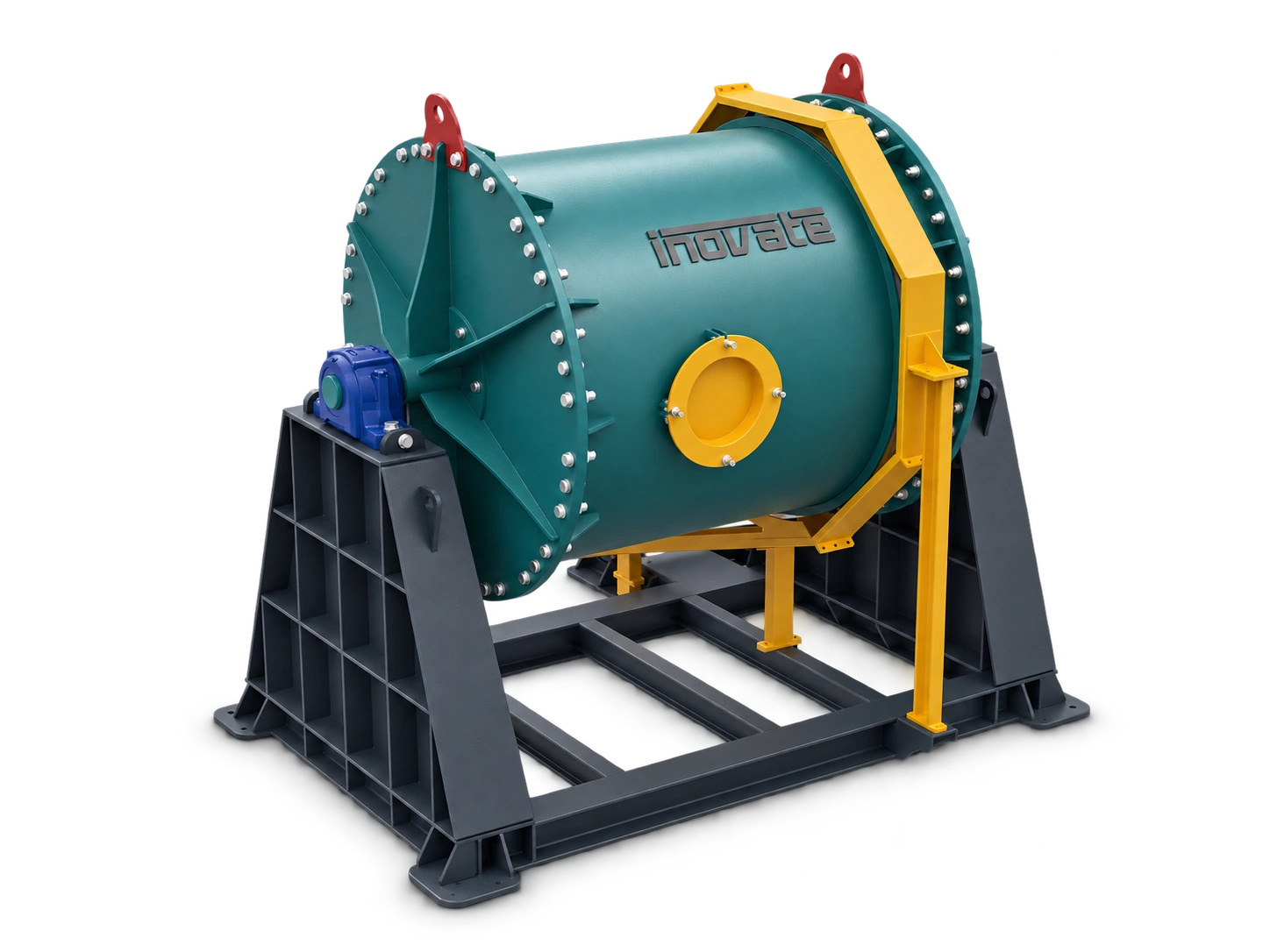
How does a ball mill grind?
As the cylindrical shell rotates, grinding balls rise, fall and contact the feed. Size reduction results from a combination of impact, compression and friction. The outcome depends on more than shell size: ball size and charge, rotational conditions, liner geometry, residence time and feed characteristics all contribute.
The first question is therefore not simply “how many tonnes per hour?” It is what material must move from which initial particle distribution to which final distribution.
What do F80 and P80 mean?
F80 is the size through which 80 percent of the feed passes; P80 is the corresponding 80-percent passing size of the product. They describe the grinding duty more usefully than one “maximum lump” or “micron target”. The full curve still matters, because two feeds with the same F80 can contain different proportions of fines and coarse particles.
Instead of stating only “5 mm feed and 100 micron product”, provide sieve analysis from a representative sample, including F80, P80 and the rest of the distribution. Unknown values should be marked for testing rather than guessed.
Why does target fineness change capacity?
A finer product can require more size-reduction work. That may mean different specific energy, residence time, media distribution or circuit arrangement. A single catalogue throughput is therefore not a project capacity unless feed and product sizes are defined.
Imagine two hypothetical projects with the same material and 10 tonnes per hour. One needs P80 at 250 microns and the other at 75 microns. The second target cannot be assumed to use the same mill, power and flow. These are not İnovate performance ratings; they illustrate why product fineness changes the selection task.
Why is grindability testwork needed?
Hardness alone does not describe grinding behaviour. Mineral structure, fractures, moisture, feed preparation and variability can affect energy demand and wear. The Bond ball mill grindability test described by SGS produces a Bond Ball Mill Work Index used to estimate net power requirements for sizing; an abrasion test can support evaluation of media and liner wear.
One representative sample is a useful starting point, but projects with changing sources or production periods need samples that capture variability. A test result is not an İnovate capacity guarantee; it is verified material data for process design.
Why do feed preparation and steady flow matter?
A ball mill does not have to perform every crushing step. If feed is coarser or more variable than expected, upstream crushing, screening and controlled feeding should be reviewed. Uneven flow can change mill filling and product distribution, while an average tonnes-per-hour figure can hide peaks.
Record typical and largest particles, F80, fines content, minimum-normal-peak flow and the feeding device. The discharge conveyor or transfer equipment must also accept the intended stream.
What is the difference between open and closed circuit?
In open circuit, material leaves the mill for the next stage. In closed circuit, a classifier separates the fine product and returns the coarse fraction for further grinding. FLS notes that ball mills can operate in closed circuit with cyclones for finer product sizing.
Capacity then belongs to the circuit, not the mill alone. Classifier or cyclone, pump, fan, filter, feeder and product transfer can all become bottlenecks. The returning load also means total flow through the mill is not the same as final product leaving the plant.
How should dry or wet grinding be selected?
Both approaches can suit different duties. Dry circuits may be chosen when the following process needs a dry product, water is undesirable or air classification is required; dust collection and sometimes drying become part of the circuit. Wet circuits require solids concentration, water balance, pumping, classification and dewatering to be assessed together.
There is no universal rule that wet is always better or dry always cheaper. Material response to water, final product form, downstream process, site infrastructure and environmental conditions determine the choice. FLS describes ball mills in both wet and dry applications with different classification and drying arrangements.
A short data list before requesting a quotation
Provide the material and representative sample; mineralogical or chemical analyses; feed distribution and F80; required product distribution and P80; minimum, normal and peak capacity; daily operating hours; wet or dry preference and its reason; existing crushers, screens, classifiers, pumps, filters and conveyors; water, power, footprint and elevation constraints; and expectations for purity, wear and cleaning.
Place unknown values in a test or measurement plan instead of treating estimates as facts. This supports a more reliable assessment of the mill and the entire circuit.
Safety and the limits of this guide
The rotating shell, drive, moving parts and stored energy can create serious hazards. OSHA requires energy sources to be identified, isolated and locked out, and the safe condition verified, to prevent unexpected startup or energy release during service. Mill entry, cover opening, blockage clearing and media or liner work must be performed only by authorised personnel under manufacturer instructions and site-specific procedures.
This article is not a sizing calculation, operating instruction or maintenance procedure. It states no capacity, motor power, diameter, media charge, dimension, certification or performance for a specific İnovate model. Final selection follows testwork and an engineering review of process and site data.
Sources
Sources were checked on the article publication date. These are general technical references, not documentation of İnovate product specifications.
