
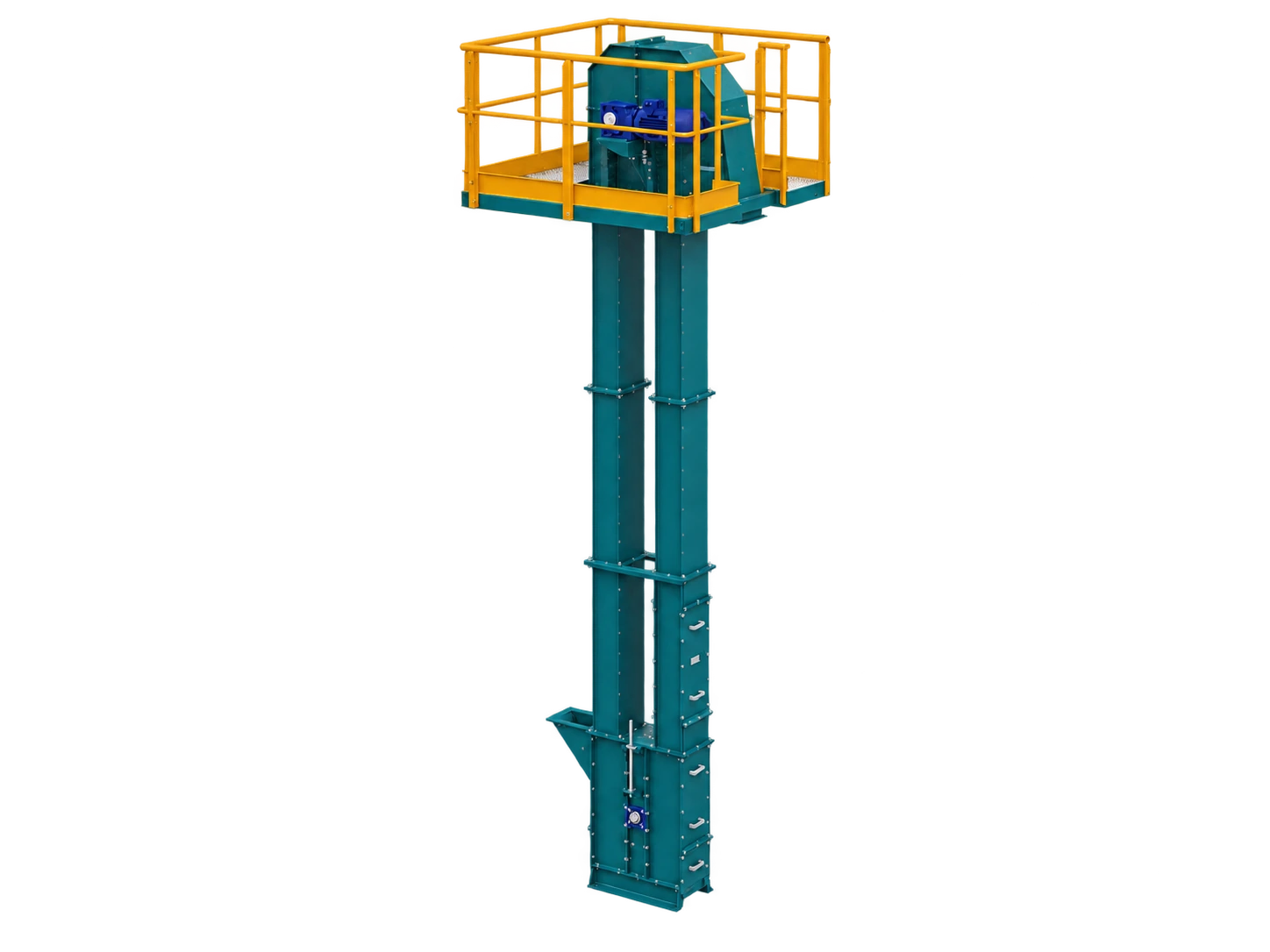
How does a bucket elevator work?
A bucket elevator lifts bulk material with buckets fixed at intervals to a belt or chain. Material enters at the boot, rises inside an enclosed casing and discharges at the head. KWS describes the main sections as the head with drive and discharge, the boot with inlet and take-up, and the intermediate casing around the carrier.
The duty is not simply to move material upwards. Buckets must fill, retain the material during travel and empty without accumulation at the head. Capacity therefore depends on inlet and outlet conditions as well as bucket volume, spacing and speed.
Why convert tonnes per hour to volume first?
Buckets carry volume. A mass-flow target must be read together with bulk density—the mass of loose material in a defined volume, including voids between particles. It is not the same as true material density.
For a hypothetical target of 12 tonnes per hour, a material at 0.80 tonnes per cubic metre needs about 15 cubic metres per hour. At 0.50 tonnes per cubic metre, the same mass target needs 24 cubic metres per hour: 60% more volume. These figures are not an İnovate model rating; they simply show why measured bulk density changes selection.
Does bucket volume alone determine capacity?
No. Theoretical volume relates to individual bucket volume, bucket spacing and carrier speed. Real throughput also depends on effective filling and discharge at the head. 4B shows that filling depends on how material enters the bucket from the front and sides, while discharge requires bucket, speed and head geometry to work together.
Closer spacing or higher speed does not produce the same proportional net gain in every application. If the inlet cannot fill the buckets, or the head cannot separate the material cleanly, theoretical capacity will not appear in service. The preliminary choice must be checked against the actual material and peak flow.
Which material properties change the decision?
Describe particle distribution, maximum lump, bulk density, moisture, flowability, stickiness, abrasiveness, temperature, friability and dust behaviour. The KWS applications table relates elevator type to bulk density, particle size, flow and abrasion classes for different materials. Products with the same general name may fill and discharge differently when moisture or fines change.
Sticky material may remain in a bucket; very fine or low-density product may respond to air movement in the casing; large lumps may interfere at the inlet or bucket opening; and abrasive material changes the wear assessment. Suitability should not be declared from a material name alone.
What separates centrifugal and continuous discharge?
A centrifugal elevator uses spaced buckets at a higher speed and directs material into the outlet by centrifugal action at the head. KWS describes this arrangement for suitable free-flowing, non-fragile bulk materials. A continuous elevator places buckets close together, runs more slowly and lets product discharge by gravity over the back of the preceding bucket; it may suit gentler handling or material unsuited to centrifugal discharge.
These definitions are a starting distinction, not a final selection. Required flow, degradation sensitivity, flow behaviour, particle size and inlet and outlet geometry must be reviewed together.
How does feeding affect capacity?
Flow into the boot must be controlled and compatible with what the buckets can accept. A daily average can hide short peaks. Excessive or uneven feed may cause accumulation in the boot, force buckets through material, create fallback and produce uneven loading along the leg.
Provide minimum, normal and peak flow, whether feed is continuous or intermittent, how upstream equipment starts and stops, and the inlet elevation. A screw or belt feeding the elevator must be evaluated with the complete line; nominal elevator capacity alone is not enough.
Why plan lift height and discharge together?
Net lift is not the same as overall equipment height. The inlet level, space for the head and drive, discharge direction, receiving equipment elevation, platforms and service access all affect the layout. The KWS design worksheet collects capacity, lift height, inlet and discharge conditions, operating schedule and environment together.
If there is insufficient room at the head or the downstream chute, silo or conveyor cannot accept the flow, the elevator cannot deliver its capacity as an isolated machine. Drawings should show roof height, structures, service areas and the material path before and after the elevator.
What data should be ready before requesting a quotation?
Provide the material and a representative sample; bulk density; particle distribution and maximum lump; moisture, temperature, flowability, stickiness, abrasiveness, friability and dust properties; minimum, normal and peak capacity; daily operating hours; net lift; inlet and outlet levels; upstream feeder and downstream equipment; indoor or outdoor environment; and cleaning, changeover and maintenance access requirements.
Mark unknown values as “to be measured” rather than turning estimates into facts. A safety data sheet, layout drawing and operating data from the existing line strengthen the assessment.
Safety and the limits of this guide
Moving buckets, a belt or chain, rotating pulleys and stored energy create serious hazards. Before maintenance, cleaning or clearing a blockage, follow manufacturer instructions and the site procedure; authorised personnel must isolate and lock energy sources and verify a safe state under OSHA 1910.147. Use only the blockage-clearing method authorised by the manufacturer and the site procedure.
Facilities with combustible dust need a separate fire and explosion risk assessment. OSHA 1910.272 sets specific provisions for inside bucket elevators within covered grain-handling facilities, including housekeeping, inspection, belt-motion and bearing monitoring; it is not a universal design prescription for every application. This article is not an operating or sizing instruction and states no İnovate capacity, power, speed, dimension, certification or performance figure.
Sources
Sources were checked on the article publication date. These are general technical references, not documentation of İnovate product specifications.
- KWS — Bucket Elevator Engineering Guide
- KWS — Centrifugal vs. Continuous Bucket Elevators
- KWS — Bucket Elevator Applications and Materials
- KWS — Bucket Elevator Design Worksheets
- 4B — Achieving Optimum Bucket Elevator Capacity
- OSHA — Control of hazardous energy (lockout/tagout)
- OSHA — Grain handling facilities
