
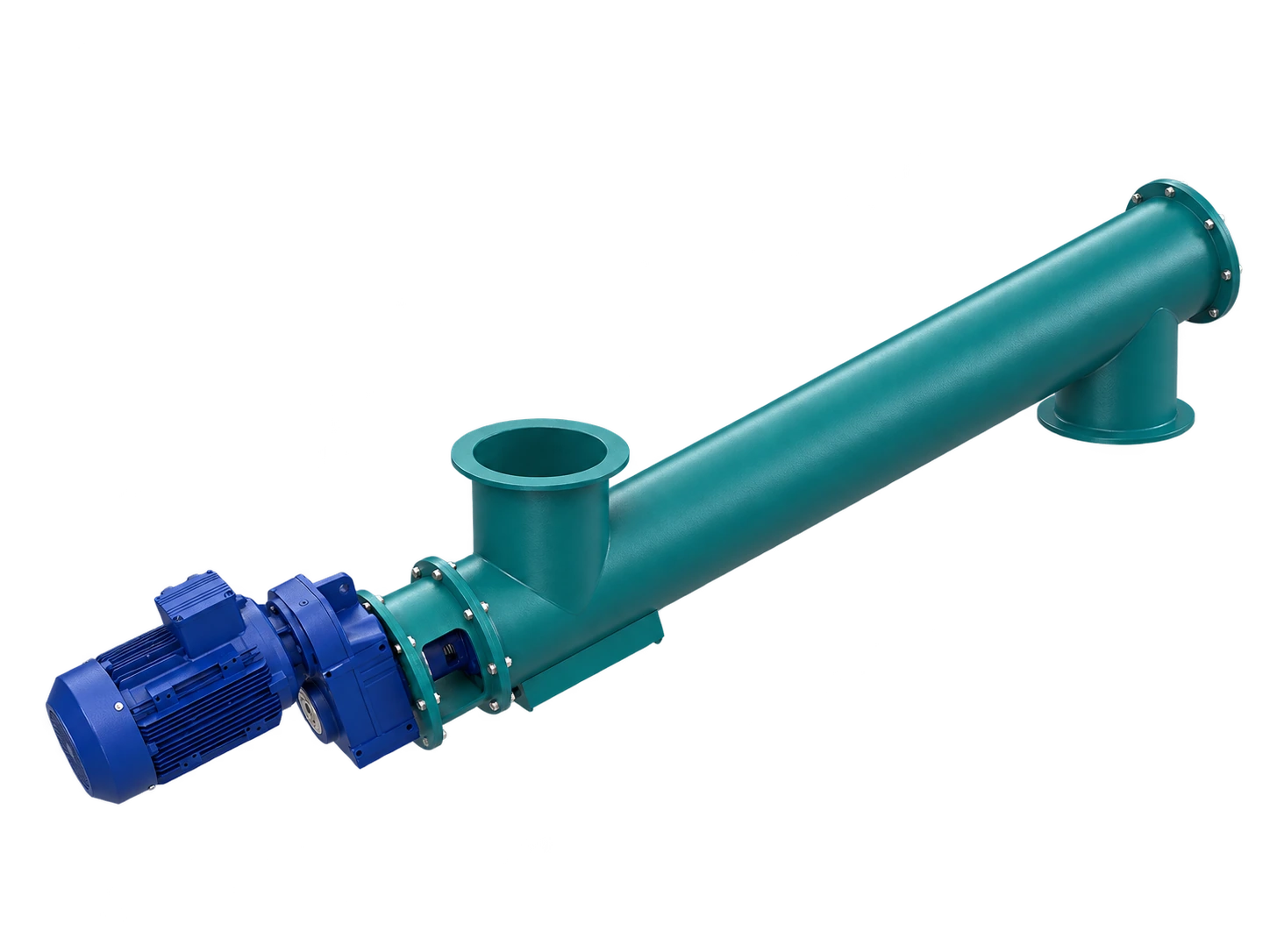
How does a screw conveyor work?
A rotating helical flight pushes suitable bulk material through a trough or tube from inlet to discharge. Enclosed construction, adaptable inlet and outlet arrangements and a compact footprint make screw conveyors useful for many short process transfers involving powders and granules. Not every material flows in the same way, however, so selection starts with material behaviour rather than the equipment name.
Screw diameter, pitch, rotational speed, trough loading and line geometry act together. Increasing only one of these variables is not a reliable selection method.
Convert mass flow into volumetric flow first
A screw conveyor handles volume. A mass-flow target therefore needs to be converted with the material’s bulk density. Bulk density is the mass of loose material in a defined volume, including the voids between particles; it is not the same as the material’s true density.
Consider a hypothetical target of 6 tonnes per hour. At a bulk density of 0.75 tonnes per cubic metre, the required flow is about 8 cubic metres per hour. At 0.50 tonnes per cubic metre, the same mass target requires about 12 cubic metres per hour. The mass target has not changed, yet the volume to be conveyed is 50 percent greater. These are not İnovate model ratings; they simply show why bulk density must be measured.
Why is a material name not enough?
A product sold under one name can behave differently as particle distribution, moisture, temperature and compaction change. Record typical and maximum particle size, bulk-density range, flowability, moisture or oil content, stickiness, abrasiveness, corrosiveness and whether the product degrades during transfer.
A light, free-flowing, non-abrasive granule should not automatically use the same loading and speed as a wet, sticky or abrasive powder. Abrasive products may require lower loading and appropriate wear provisions; sticky products may need special flight and housing evaluation. A trade name alone cannot support those decisions.
Assess trough loading and speed together
A simple diameter calculation that assumes a completely full housing can mislead for a normal screw conveyor. Suitable trough loading changes with flowability, density and abrasiveness. The KWS guide shows higher loading for light, free-flowing materials and lower loading for dense, sluggish or abrasive products. Those figures are not direct İnovate design limits; they demonstrate why material classification belongs in the calculation.
Higher speed may increase theoretical volume, but it is not always the better answer. Wear, product degradation, aeration, power demand and interaction with hanger bearings can also change. Diameter, speed, pitch and loading are therefore selected together rather than from motor power or speed alone.
A screw conveyor and a screw feeder do different jobs
The flow entering a screw conveyor is normally controlled by another device. A screw feeder operates with a flood-loaded inlet below a hopper or silo and meters material into the downstream process. Flood loading brings head pressure, compaction, starting torque and even extraction across the inlet into the design.
“We will put a screw below the hopper” is therefore incomplete. Is the task only to transfer a controlled stream, or must the screw establish the feed rate from storage? What are the inlet length and shape? Are minimum and maximum rates required? A standard conveyor calculation should not be applied to a feeder before these questions are answered.
Why does capacity become harder as incline increases?
Material moving between flights on a horizontal line becomes more likely to fall back under gravity as incline increases. Net volume at the same diameter and speed may fall, while power and torque requirements can change. Flow behaviour, trough or tubular housing and screw pitch all affect inclined performance.
Do not copy a horizontal calculation and merely add an angle. Provide start and finish elevations, true horizontal distance, incline, inlet and outlet positions and the material that may remain after a stop. For steep lifts, compare the screw with other principles, such as a bucket elevator, at system level.
Layout and process connections are part of capacity
A calculated screw capacity does not become useful output if the upstream device feeds unevenly or the downstream machine cannot accept the stream. Inlet chute, discharge direction, hanger bearings, seals, cleaning access and space for maintenance removal should be assessed during layout.
If a process averages 8 cubic metres per hour but briefly peaks at 14, sizing only for the daily average can hide an overflow or build-up risk. This is a hypothetical planning example, not a performance claim. Minimum, normal and peak flows should be stated separately.
A short data list before requesting a quotation
Share the material and, where possible, a representative sample; bulk-density range; typical and maximum particle size; moisture, temperature, stickiness, abrasiveness and corrosiveness; minimum, normal and peak flow; operating duration; horizontal length, elevation difference and incline; number and location of inlets and outlets; upstream and downstream equipment; acceptable cross-contamination; and cleaning and product-contact requirements.
Mark unknown values as “to be measured” instead of guessing. These facts support technical assessment of flight geometry, housing arrangement, drive and construction materials.
Safety and the limits of this guide
Rotating screw flights create entanglement and trapping hazards. OSHA expressly requires guarding that prevents contact with turning flights and requires conveyors to be rendered inoperable and tagged during repairs or hazardous maintenance. Covers, blockage clearing, cleaning and maintenance must be handled only by authorised personnel under the machine manufacturer’s instructions and the site’s energy-isolation procedures.
This article is not a design calculation, operating instruction or maintenance procedure. It states no diameter, capacity, speed, motor rating, dimension, certification or performance for a specific İnovate model. Final selection requires an engineering review of the material, process and site data.
Sources
Sources were checked on the article publication date. These are general technical references, not documentation of İnovate product specifications.
