
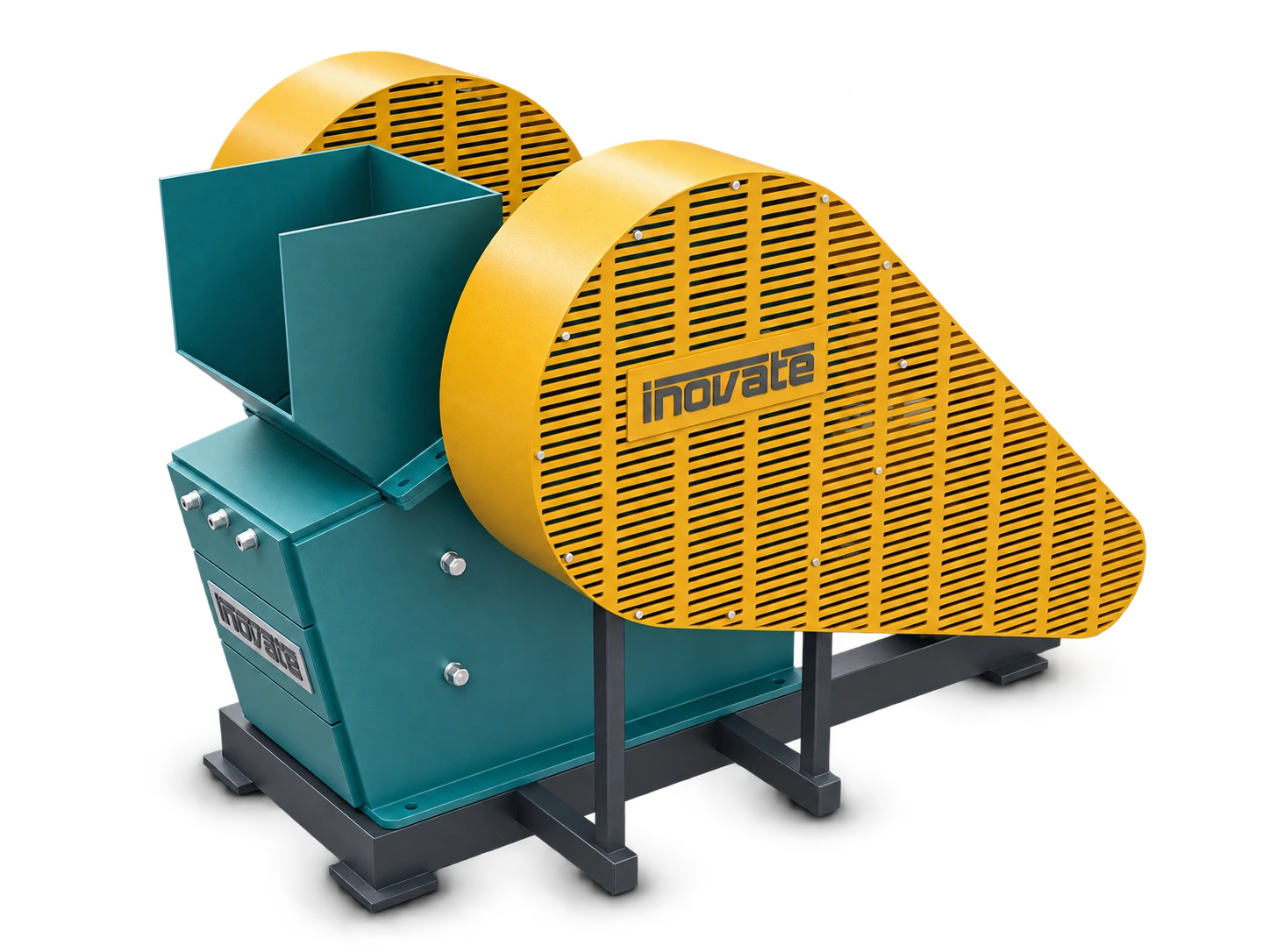
How does a jaw crusher reduce material?
A jaw crusher compresses material between a fixed and a moving jaw. Pieces travel downwards as they become small enough to pass the discharge opening. Selection therefore considers the largest incoming lump, required discharge distribution and the material’s breaking behaviour together.
Feed opening is not the same as permitted feed size
The feed opening defines the inlet geometry, but it does not mean that every lump of the same size can be fed safely. Jaw profile and thickness alter the available space. Long, flat or irregular pieces can also affect the risk of bridging at the inlet.
Metso, for example, uses an approximate 80% relationship in its own Nordberg C Series application guide. This is not an İnovate limit or a universal rule for every jaw crusher. The selected machine’s manufacturer data and actual jaw geometry must govern each project.
Record the largest and most difficult lump, not only the average
“Feed is about 250 mm” is not enough. Record the largest lump, typical size distribution and whether long or flat pieces occur.
In a hypothetical case, most feed is below 250 mm but occasional flat pieces reach 450 mm. The average appears small, yet those 450 mm pieces affect inlet selection, pre-screening and oversize management. This is not an İnovate model rating; it illustrates the site information that must be measured.
What is CSS and why does it affect capacity?
CSS is the closed-side setting when the moving jaw is closest to the fixed jaw. A smaller setting changes how material passes through the chamber and alters product distribution; capacity, power draw and wear can also be affected. Discharge is not a single particle size: CSS is a major influence on the distribution, not a guarantee of one exact product size.
Confirm the permitted minimum CSS in the instructions for the actual machine and jaw profile. When a finer product is required, assess the following crushing and screening stages instead of relying only on a tighter setting.
How do material properties change capacity?
Two materials with the same particle size may behave differently. Gradation, bulk density, moisture, clay content and crushability are key capacity inputs. Abrasiveness and impact loads also matter when selecting jaw profile and wear material.
Instead of a broad label such as “hard stone”, provide the material name, available analyses, moisture or clay conditions and variability. Sandvik likewise relates jaw-plate selection to rock or ore and feed characteristics; one profile does not suit every application.
Why are the feeder and pre-screen part of selection?
Crusher capacity is connected to how material enters the chamber. Uneven or one-sided feeding can reduce effective use of the chamber. Removing material finer than the discharge setting with a suitable pre-screen arrangement can reduce unnecessary contact and wear.
Feeder width, controllable rate and the ability to transfer oversize material safely should be reviewed with the crusher. This is project-planning guidance, not an operating procedure.
Why is target tonnes per hour not enough?
A catalogue capacity range depends on specified feed, material and setting conditions. Actual line output is influenced by the narrowest point across the feeder, crusher, discharge chute, belt conveyor, screen and any secondary crusher. A larger primary crusher cannot turn flow that the downstream conveyor or screen cannot accept into useful production.
If a crusher could hypothetically process 120 tonnes per hour but its discharge conveyor or screen were limited to 90, the line target could not be treated as 120. These figures explain a bottleneck; they are not product performance ratings. Layout and downstream loads must be checked during selection.
A short data list before requesting a quotation
Provide the material and verified properties; largest lump and typical gradation; moisture, clay and fines; target hourly flow; required discharge distribution; shift duration; feeding method; downstream conveyors, screens and machines; and site footprint and height limits.
Mark unknown values as “to be measured” rather than presenting estimates as facts. A representative sample and existing process data strengthen the technical assessment.
Safety and the limits of this guide
Unexpected movement or stored energy during blockage clearing, cleaning and maintenance can cause serious injury. Only authorised personnel should work according to the machine manufacturer’s instructions and the site’s energy-isolation and lockout procedures. This article is not an operating or maintenance instruction.
No specific İnovate feed opening, capacity, motor rating, dimension, certification or performance is claimed here. Final selection follows a technical review of material, process and site data.
Sources
Sources were checked on the article publication date. These are general technical references, not documentation of İnovate product specifications.
