
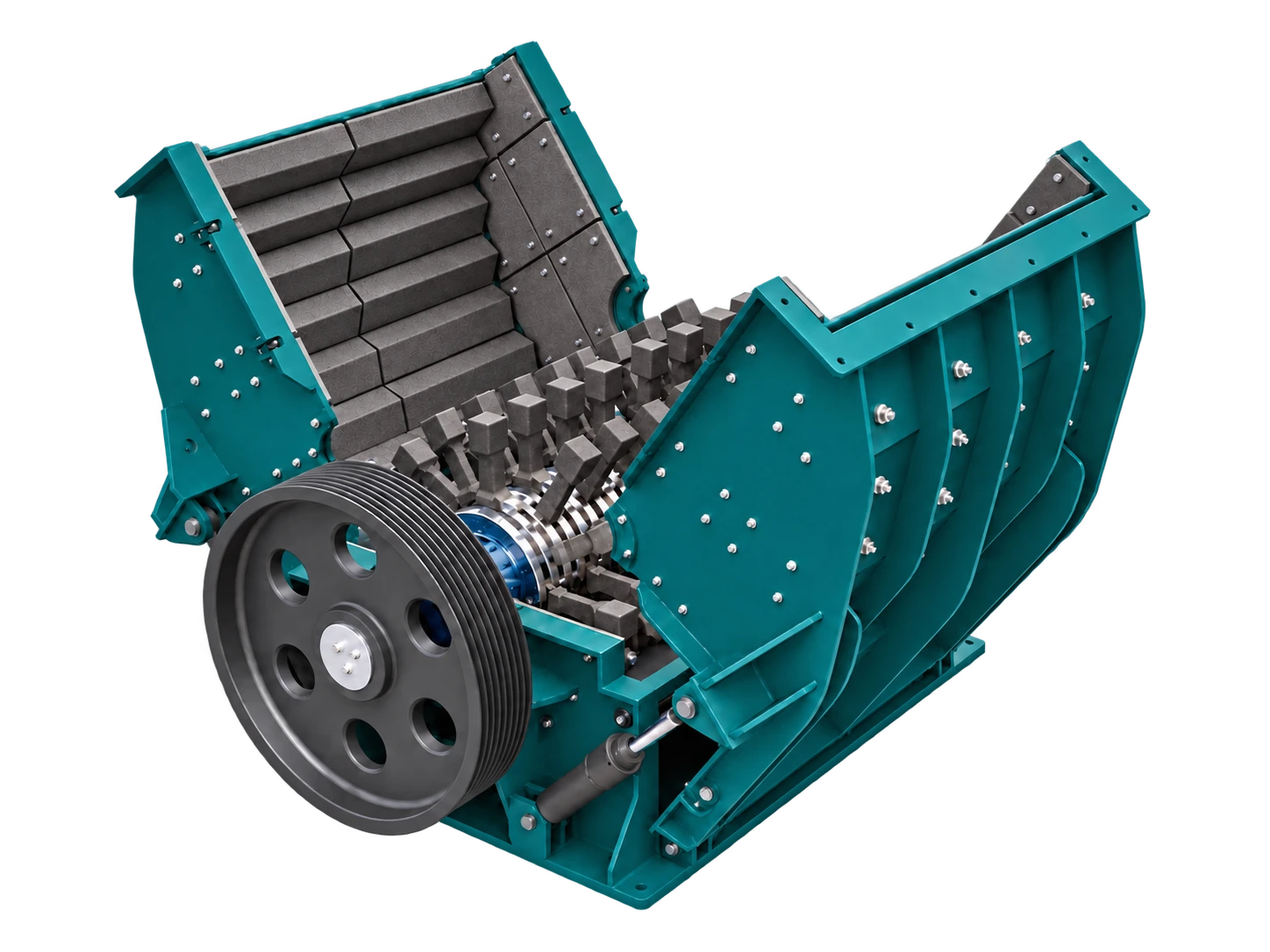
How does a hammer crusher work?
Hammers on a rotating rotor strike the feed. Particles meet the hammers, crushing surfaces and one another; sufficiently small material passes through the discharge grate. MEKA explains that grate spacing influences final size and rotor circumferential speed can also change the result.
This principle does not prove suitability. Brittle feed that breaks readily behaves differently from material that sticks, absorbs impact or creates heavy wear. Selection starts by matching the mechanism to the real feed.
Why is a material name not enough?
Limestone, gypsum or coal is useful as a first description, but samples can differ in hardness, mineralogy, silica, moisture and fines. Those differences change crushability, power demand, passage through the grate and wear. MEKA describes hammer crushers particularly for suitable medium-hard to soft, low-abrasive feeds.
Do not reduce the decision to one hardness value. HAZEMAG’s programme considers input gradation, moisture, chemistry, Los Angeles testing, output gradation and breakage pattern together. A representative sample is stronger evidence than a general name.
How do moisture and fines change the decision?
Moisture combined with fines may make material adhere to itself or machine surfaces. The inlet can narrow, open grate area can fall and throughput can fluctuate. Record the highest realistic moisture after rain or process variation as well as the average.
Some specialised double-rotor designs are made for moist, cohesive feed; HAZEMAG HDS and thyssenkrupp titan are manufacturer-specific examples. A capability published for one model cannot be transferred to every crusher. Adhesion, fines and any need for drying or pre-screening require project-specific verification.
Why provide both maximum feed size and gradation?
The largest lump only shows whether it can enter. The proportions of coarse, medium and fine particles change rotor loading and the amount reaching the grate. Two feeds with the same maximum size can produce different throughput and products.
Provide a representative sieve analysis, normal and maximum lump, risk of uncrushable objects, continuous or intermittent feeding, and minimum-normal-peak flow. HAZEMAG likewise compares input and output distributions using samples. The feeder and any pre-screen belong to the complete circuit decision.
Is one target product size enough?
No. A request for a “10 mm product” does not say whether every particle, most particles or only the top size is meant. Specify the product curve, allowable oversize and unwanted fines. Grate spacing matters, but rotor speed, feed distribution, crushability, wear and circuit arrangement also influence the result.
If the product feeds a ball mill, screen or another machine, that equipment’s acceptable feed becomes part of the target. In closed circuit, returned screen oversize adds to fresh feed when assessing actual crusher load.
Why is capacity not a fixed catalogue number?
A tonnes-per-hour figure is meaningful only with its material, gradation, moisture and product target. MEKA states that indicative capacity can change with feed gradation, moisture, crushability, crusher speed, installed power and circuit design.
Record minimum, normal and peak flow separately. Check whether the feeder regulates that flow and whether the downstream conveyor and screen accept it. HAZEMAG evaluates capacity, power, gradation, wear and moisture for the application; testing can be more reliable than catalogue comparison when the feed is uncertain.
How should wear and maintenance enter selection?
Hammers, grate elements and housing liners contact the material directly. As abrasiveness rises, part material, inspection frequency, spares and planned downtime become more important. thyssenkrupp treats hammer grades, grate baskets, liners and rotor service as distinct items, while HAZEMAG notes that wear rates can be evaluated through testing.
Show maintenance access from the start: space for opening covers, a safe lifting path and service platforms should not be left to whatever space remains. Compare wear parts by suitability, replacement interval and downtime as well as price.
What information should be ready before a quotation?
Provide the material and a representative sample; mineralogical or chemical analysis when available; hardness and abrasiveness; normal and maximum moisture; particle distribution and maximum lump; risk of uncrushable objects; minimum-normal-peak capacity; product curve and fines limit; feeding method; open or closed circuit; operating hours; indoor or outdoor location; dust control and maintenance access.
Mark unknown values “to be measured” rather than turning estimates into facts. This supports a sound comparison between a hammer crusher, another method and the feeder-screen-conveyor arrangement.
Safety and the limits of this guide
The rotor, hammers and drive store substantial energy. Before inspection, replacement, cleaning or clearing a blockage, follow manufacturer instructions and the site procedure; authorised personnel must isolate electrical, mechanical, hydraulic, pneumatic and other stored energy and verify a safe state. OSHA warns that unexpected start-up or energy release during servicing can cause serious or fatal injury and describes lockout/tagout under 1910.147.
This article is not an operating, maintenance or sizing instruction. It states no capacity, power, feed size, moisture limit, dimension, certification or performance value for any İnovate model.
Sources
Sources were checked on the article publication date. These are general technical references, not documentation of İnovate product specifications.
