
What does moisture content mean?
Moisture content is the amount of water in a sample divided by a defined reference mass. It is not the same as ambient relative humidity: relative humidity describes the air, while material moisture describes the sample. A percentage is incomplete unless the reference is identified as the wet sample or dry solids.
In an equipment project, moisture is more than a quality value. It can be linked to adhesion, agglomeration, flow behaviour and the choice between wet and dry processing. The same percentage does not guarantee the same behaviour in different materials. A clay-bearing mineral, cereal, polymer granule and hygroscopic powder may require different sampling and analysis methods.
How are wet-basis and dry-basis moisture calculated?
Wet-basis moisture divides water mass by total wet mass: Mwb (%) = (mwet − mdry) / mwet × 100. Dry-basis moisture divides water mass by dry-solid mass: Mdb (%) = (mwet − mdry) / mdry × 100. FAO shows that the two bases give different numbers for the same sample, so the basis must be stated.
Suppose a 10.00 kg sample weighs 8.80 kg after the defined drying method. The measured mass loss is 1.20 kg. The wet-basis result is 1.20 / 10.00 × 100 = 12.0%, while the dry-basis result is 1.20 / 8.80 × 100 ≈ 13.6%. Both describe the same sample. They are an arithmetic example, not an operating limit for any İnovate machine.
Is there one oven method for every material?
No. In a loss-on-drying method, the container and sample are weighed, dried under conditions defined by the relevant standard, cooled in a controlled way and weighed again. Temperature, duration, sample mass, preparation and end point are material-specific. If volatile components, decomposition or loss of bound water occur, the mass loss may not represent only free water.
ASTM D2216 covers water content by mass for soil, rock and similar materials, while warning that gypsum-bearing or organic samples can respond differently to the standard temperature. ISO 712-1:2024 is a reference method for specified cereals and products and expressly excludes maize and pulses. These examples show why one temperature-and-time recipe found online cannot be transferred to every raw material. Use the current standard or validated laboratory procedure applicable to the material and sector.
Why do representative sampling and reporting matter?
Sampling only the dry surface of a lot or one visibly wet point may not represent the batch. Define the lot, production state, locations, interval and whether increments are combined. Store the sample in a suitable closed container that limits moisture exchange and record the delay before analysis. FAO likewise recommends representative locations and a sealed container before grain analysis.
Report material and lot, sampling location and date, wet or dry basis, method and standard edition, initial and final masses, preparation, temperature and duration, number of replicates, mean and spread. If a portable meter is used, record material-specific calibration and verification against the reference method. A measured minimum, typical and maximum range is more useful than the phrase “normal moisture.”
How does moisture affect equipment selection?
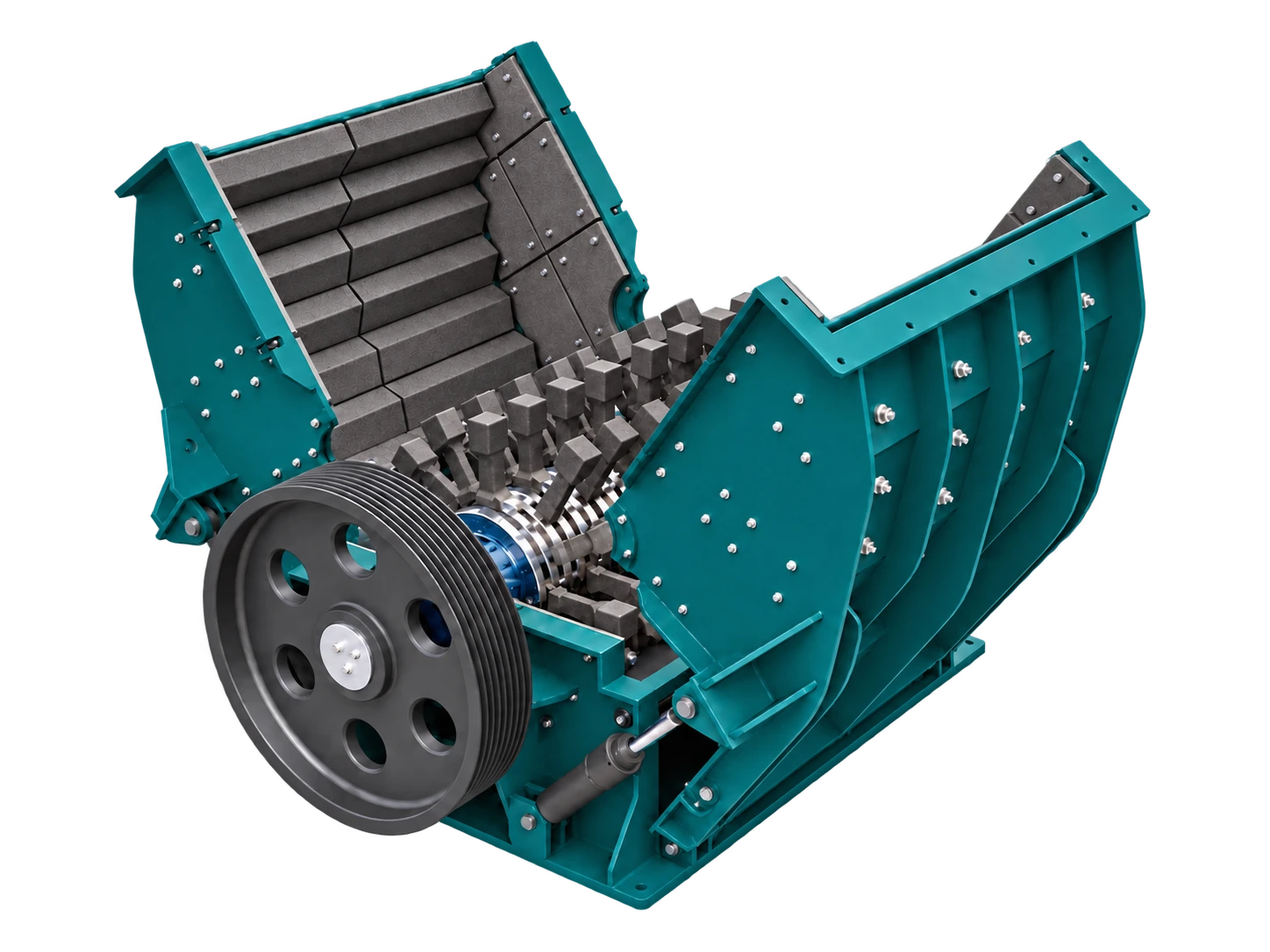
For crushing, measured moisture is considered together with stickiness and clay content. HAZEMAG’s hammer-crusher example for wet and tough feed shows that suitability comes from a particular design and feed definition, not from the machine name alone; it cannot be transferred as a performance claim for another model. In grinding, wet or dry operation is also a process-route decision; FLS presents different ball-mill arrangements for both.
In conveying, increasing moisture can change packing, agglomeration or corrosion behaviour for some materials. KWS identifies these special characteristics as screw-design inputs. Where controlled liquid addition is required in a ribbon blender, ROSS recommends validating flow, spray and solid–liquid interaction because uncontrolled addition can produce wet lumps. Report moisture with bulk density and particle-size distribution; do not use it alone as a capacity calculation.
Short checklist for project assessment
Provide the material’s trade and technical name, a representative sample, a moisture range with wet/dry basis identified, the method, particle-size distribution, bulk density and observations of adhesion or lumping. Separate normal and worst-case conditions caused by rain, washing, drying, liquid addition or storage. If moisture can change between sampling and processing, include the sample time.
Never reach into an operating crusher, belt, screw, elevator, mill or blender or open guards to take a sample. Use designed external sampling points and the site procedure. If cleaning, clearing or maintenance can expose hazardous energy, follow the manufacturer instructions and the site energy-isolation and lockout procedure. This article is not a laboratory, operating or maintenance instruction.
Start an assessment with your moisture report and process data
Sources
Sources were checked on the article publication date. These are general technical references, not documentation of İnovate product specifications.
- FAO — Grain drying: moisture content on wet and dry basis
- ASTM — D2216: Water content of soil and rock by mass
- ISO — 712-1:2024, Moisture content of cereals and cereal products
- KWS — Factors Influencing Screw Conveyor Design
- HAZEMAG — Hammer Crushers
- ROSS — Tips for liquid addition in a ribbon blender
- FLS — Ball Mills for wet and dry grinding
- OSHA — The control of hazardous energy (lockout/tagout), 1910.147
