
What does uniformity mean?
Uniformity means that a selected component is present within an accepted variation in separate samples of a defined size. This raises three linked questions: which component is measured, how large is each sample and what is the acceptance criterion? Looking only at the colour or surface of the blend does not answer them.
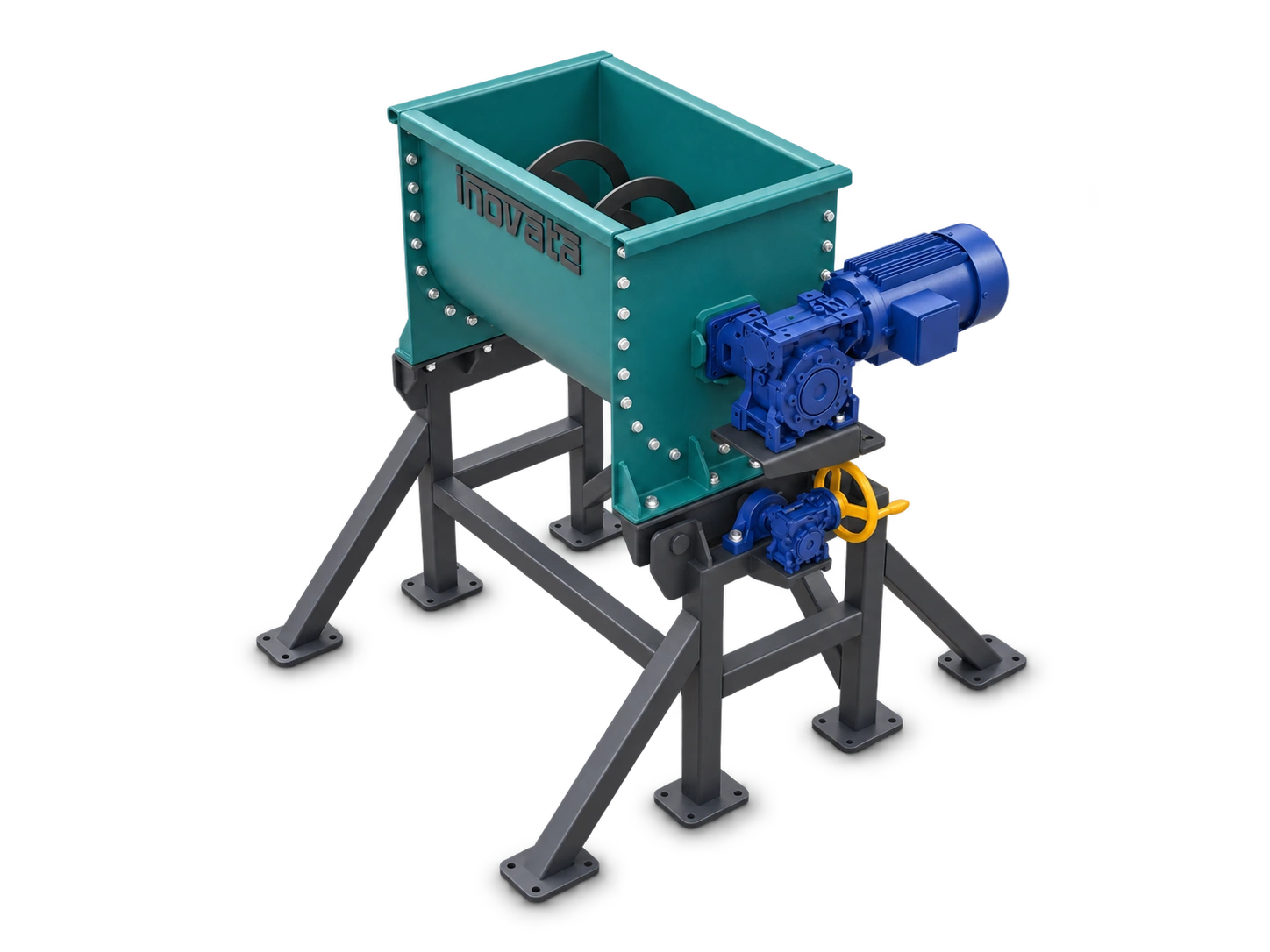
A ribbon blender moves material axially and radially with inner and outer ribbons. Its operating principle alone does not guarantee the same result for every formulation. Particle size, bulk density, shape, moisture, cohesion and ingredient ratios change the conditions that must be verified.
Define the measured component and test plan first
Record the formulation, normal batch size, fill condition, order of addition and proposed mixing time before the test. Select a component or suitable tracer that occurs at a useful low concentration, can be measured with sufficient accuracy and remains stable through the process. If the analyte comes from more than one raw material, account for its starting contribution.
Write down the number and mass of samples, sampling point, interval, analytical method and acceptance rule before testing. ASABE and GMP+ formalise this approach for feed processes; other sectors have their own regulations, quality systems and product risks. This article is not a substitute for a sector-specific validation protocol.
Sampling: reveal differences instead of averaging them away
When the objective is to measure variation among samples, do not combine samples from different positions into one container. A composite can turn local differences into an average. Keep samples separate, take them from defined positions or at regular intervals during discharge and label each one. GMP+ requires at least ten samples in its feed scope, but the appropriate number depends on batch size, method and required confidence; it is not an automatic rule for every sector.
Sampling location also changes the question being answered. To evaluate only the blender, target the blender or its discharge. To verify packed product, include discharge and downstream transfer by screw or belt, because differences in particle size and density can permit re-segregation. Sample mass should represent the scale at which the product is used: an overly large sample can mask local variation, while an excessively small one can magnify analytical uncertainty.
How is CV calculated, and what does it not tell you?
The coefficient of variation is the standard deviation divided by the mean: CV (%) = standard deviation / mean × 100. If a component averages 1.00% across separate samples and the standard deviation is 0.08 percentage points, the CV is 8%. This is only an arithmetic example; 8% is not an acceptance limit in this guide.
Within the same test plan, a lower CV indicates that the results are closer together. But the result is influenced by concentration, sample count and mass, analytical repeatability and sampling location. Do not compare CV values produced by unlike methods without context. Set acceptance against sector requirements, product risk, customer specifications and a validated analytical method.
How should mixing time be established?
Do not copy one catalogue or online time directly into a formulation. Run a time series using representative raw materials, the normal fill condition and the actual order of addition. Results taken at different times with the same method can show when CV reaches a stable level. Repeat batches where necessary to check repeatability.
More time is not always better. Fragile particles may be damaged, mixtures with size or density differences may re-segregate, and the production cycle may be extended without benefit. Consider the shortest validated time together with total loading and discharge time. Reassess validation when the recipe, raw-material source, fill level, equipment setting or a significant line component changes.
Process details that influence the result
Large differences in particle size or density, very-low-dose ingredients, moisture, cohesion or electrostatic charge, liquid-addition method, agglomerates and uncontrolled addition order can all affect uniformity. A suitable preblend may help distribute a minor ingredient in some formulations, but its suitability must also be demonstrated by product trials.
On the machine, operating fill range, ribbon-to-trough clearances, wear, build-up and discharge design matter. Downstream, consider drop height, transfer points, conveyors and storage. A poor result should not automatically be treated with longer mixing; investigate the whole chain, including possible sampling and analytical error.
Checklist for an enquiry and project assessment
Provide formulation components and ratios, minimum/normal/maximum batch sizes, measured bulk densities, particle-size distributions and moisture state. Rather than specifying an assumed mixing time, describe the current cycle, order of addition, liquid addition, cleaning needs and the product route after the blender. Add the component your quality team intends to measure, the sampling plan and any applicable sector criterion.
Never open or reach into an operating blender to collect a sample. Use designed external sampling points and the site procedure. When cleaning, clearing or maintenance exposes personnel to hazardous energy, follow the manufacturer’s instructions and the site’s energy-isolation and lockout procedure. This article is not an operating instruction.
Start an assessment with your formulation and test objective
Sources
Sources were checked on the article publication date. These are general technical references, not documentation of İnovate product specifications.
- Kansas State University — Testing Mixer Performance (MF3393)
- ASABE — ANSI/ASAE S303.4, Test Procedure for Solids-Mixing Equipment for Animal Feeds
- GMP+ International — TS1.11 Control of residues & homogeneity
- ROSS — Four practical ways to optimize your batch ribbon blender’s efficiency
- OSHA — The control of hazardous energy (lockout/tagout), 1910.147
